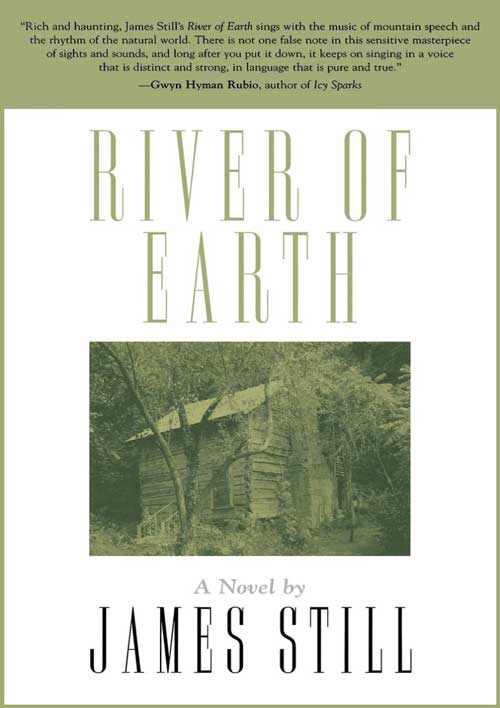
James Still’s novel, “River of Earth,” continues to please old readers and to find new ones. Set in Appalachian Kentucky, it is a genuine classic.
Told from the viewpoint of a small boy, the story encompasses about three years in the life of his family and kin. The family moves back and forth between their small farm and eastern Kentucky coal camps, where the father, Brack Baldridge, works when there is work.
 The mother, Alpha Baldridge, longs for a place “certain and enduring” and complains of “Forever moving yon and back, settling down nowhere for good and all, searching for god knows what . . . Where air we expecting to draw up to?” Meanwhile the seasons come and go. Animals, wild and domestic, are born and die, as does the narrator’s grandmother, at about the same time Alpha Baldridge gives birth to another child.
This is a story both simple and profound. For all the events of the novel—the family’s moves, the changing seasons, and the cycle of birth and death—are echoed in the sermon of a mountain preacher, Brother Sim Mobberly, who speaks of the hills: “These hills are jist dirt waves, washing through eternity. My brethren, they hain’t a valley so low but what hit’ll rise again. They hain’t a hill standing so proud but hit’ll sink to the low ground o’ sorrow. Oh, my children, where air we going on this mighty river of earth, a-borning, begetting, and a-dying—the living and the dead riding the waters? Where air it sweeping us?”
The secret of the novel’s enduring power lies in such unspoiled and glorious language. The novel’s power lies also in Still’s narrative art. By bringing out the big subjects in small events, Still makes the life of the Baldridge family, swept along on the mighty river of earth, a metaphor for the universal human experience.
“Of course, you have to tell the story,” Still once said. “Then you take all the telling out so that the story just happens.”
“River of Earth” is a story that appears to “just happen.”
Like other world-famous stories, James Still’s “River of Earth” is a book that is never finished saying what it has to say. Though published more than 85 years ago, Still’s novel retains a freshness and immediacy that makes it permanently contemporary.
Early on, the young narrator says: “I was seven on the twenty-first of May, and I remember thinking that the hills to the east of Little Carr Creek had also grown and stretched their ridge shoulders, and that the beechwood crowding their slopes grew down to a living heart.”
Still’s “River of Earth” grows down to a “living heart.” A combination of uniqueness and universality, it brings us “news that stays news.” In 1940 Stephen Vincent Benet declared it “a contemporary book”; and so it is today, as fresh and vital as on the day it was published.
“River of Earth,” like other Appalachian classics, is available at the JSF Bookstore, 4440 13th Street in Ashland or by calling 606.326.1667.
By James M. Gifford
JSF CEO & Senior Editor
James Still’s novel, “River of Earth,” continues to please old readers and to find new ones. Set in Appalachian Kentucky, it is a genuine classic.
Told from the viewpoint of a small boy, the story encompasses about three years in the life of his family and kin. The family moves back and forth between their small farm and eastern Kentucky coal camps, where the father, Brack Baldridge, works when there is work.
The mother, Alpha Baldridge, longs for a place “certain and enduring” and complains of “Forever moving yon and back, settling down nowhere for good and all, searching for god knows what . . . Where air we expecting to draw up to?” Meanwhile the seasons come and go. Animals, wild and domestic, are born and die, as does the narrator’s grandmother, at about the same time Alpha Baldridge gives birth to another child.
This is a story both simple and profound. For all the events of the novel—the family’s moves, the changing seasons, and the cycle of birth and death—are echoed in the sermon of a mountain preacher, Brother Sim Mobberly, who speaks of the hills: “These hills are jist dirt waves, washing through eternity. My brethren, they hain’t a valley so low but what hit’ll rise again. They hain’t a hill standing so proud but hit’ll sink to the low ground o’ sorrow. Oh, my children, where air we going on this mighty river of earth, a-borning, begetting, and a-dying—the living and the dead riding the waters? Where air it sweeping us?”
The secret of the novel’s enduring power lies in such unspoiled and glorious language. The novel’s power lies also in Still’s narrative art. By bringing out the big subjects in small events, Still makes the life of the Baldridge family, swept along on the mighty river of earth, a metaphor for the universal human experience.
“Of course, you have to tell the story,” Still once said. “Then you take all the telling out so that the story just happens.”
“River of Earth” is a story that appears to “just happen.”
Like other world-famous stories, James Still’s “River of Earth” is a book that is never finished saying what it has to say. Though published more than 85 years ago, Still’s novel retains a freshness and immediacy that makes it permanently contemporary.
Early on, the young narrator says: “I was seven on the twenty-first of May, and I remember thinking that the hills to the east of Little Carr Creek had also grown and stretched their ridge shoulders, and that the beechwood crowding their slopes grew down to a living heart.”
Still’s “River of Earth” grows down to a “living heart.” A combination of uniqueness and universality, it brings us “news that stays news.” In 1940 Stephen Vincent Benet declared it “a contemporary book”; and so it is today, as fresh and vital as on the day it was published.
“River of Earth,” like other Appalachian classics, is available at the JSF Bookstore, 4440 13th Street in Ashland or by calling 606.326.1667.
By James M. Gifford
JSF CEO & Senior Editor